




Gypsum vs PVC False Ceilings
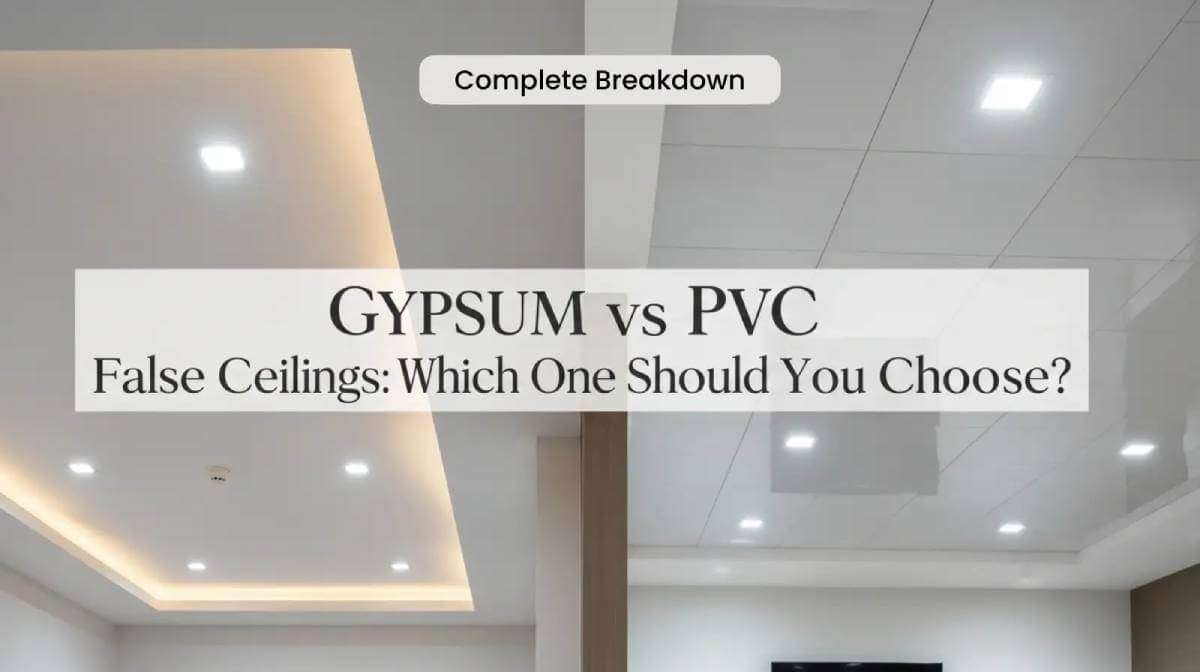
A ceiling doesn’t just hover above you. It controls how light moves, how sound behaves, and sets the tone for room temperature. And that’s why the false ceiling, once a luxury, is now a modern essential. It conceals the messy wiring. and redefines the room’s character with a single sweeping plane of design.
But here’s the problem. Renovators today are drowning in confusion because there are so many ceiling options available: POP ceilings, wooden ceilings, metal ceilings, and glass ceilings. Yet one debate rises to the top every single time: Gypsum vs PVC false ceiling. Two commonly used choices. Two very different materials.
This blog will give you the crystal clear information to make that decision. We will give you an in-depth breakdown of aesthetics, durability, cost realities, installation, and long-term safety so you can choose with clarity and confidence. By the end, you’ll know exactly which ceiling belongs in each room of your home and why.
Gypsum vs PVC Ceiling: Understanding the Options
Let’s begin with the basics. Without this foundation, the comparison feels like guesswork. And guesswork has no place in a renovation project that will shelter your head for decades.
Gypsum
Gypsum is a naturally occurring mineral. Calcium Sulfate. Pulled from the earth, heated, processed, and formed into boards; known in the construction industry as drywall or plasterboard. It’s Stable. Predictable. It’s the golden standard for quality. When someone says seamless ceiling, they’re talking about gypsum. When you imagine those perfect curves, floating coves? It's gypsum.
PVC
PVC is different. Artificial. Manufactured. A synthetic polymer: Polyvinyl Chloride. Crafted in a factory, not on Earth. It's lightweight and has a waterproof surface. And irresistibly budget-friendly for many families. It snaps together in neat interlocking panels, almost like assembling a floor above your head. The result is practical, clean, and functional. It delivers convenience where gypsum delivers beauty.
And so the decision-making confusion starts. Aesthetic Perfection versus Practical Durability. A ceiling that looks like it came from an architect’s sketchbook versus one that is unaffected by moisture and mess and is practically hassle-free.
Which one wins? The answer depends on what you, your space and your lifestyle demand.
Difference Between Gypsum and PVC Ceiling
Aesthetics and Finish
Gypsum
Gypsum is the symbol of luxury. When installed, contractors screw the board onto a metal frame. Then the joints become invisible under a smooth coat of POP paste. What remains is one continuous surface with no interruption. No groove lines. Just a clean, calming plane overhead. From a design point of view, nothing matches the versatility of gypsum. You want curves, waves, recessed lighting channels? Gypsum can deliver that.
PVC
PVC tells a different story. It comes in panels or planks that interlock. Easy for installers. But those joints? They stay visible. Thin shadow lines. Groove-like patterns that appear every few inches. Some homeowners like that texture, but aesthetically, many don’t want the ceiling to look like that. And the finishes: wood grains, marbles, metallics, offer variety but can look artificial under natural daylight.
So what matters here? Atmosphere. Long-term visual comfort. Gypsum achieves a designer’s vision; PVC finish focuses more on practicality.
Durability and Strength
Gypsum
Gypsum is strong but does not handle moisture well. A tiny roof leak can cause yellow blooms across the surface. Worse, it begins to sag or develop fungal spots if the moisture persists. You can repair it, but the damage is slow and sneaky. You don't see it coming until it's there.
PVC
PVC, meanwhile, refuses to be defeated by moisture. It’s waterproof. Termite-proof. Humidity-proof. You can install it in bathrooms, and years later, it will still be spotless, or you can try a perforated acoustic ceiling for better performance. But PVC has a weakness of its own: heat. Put it too close to a stove, a hot exhaust vent, or powerful downlights, and it may warp or discolor.
So which is “more durable”? Depends on the environment. Water kills gypsum. Heat bothers PVC. Choose wisely.
Gypsum Installation Process
Renovators who’ve lived through a gypsum installation will never forget it. The process is tedious and labor-intensive, involving framing, boarding, taping, jointing, sanding, and finally finishing. And the dust enters into corners you didn’t know existed. It takes time, and that can be another hassle if you are working on a tight schedule. Anywhere from three to seven days, depending on the size and complexity of your design.
PVC Installation Process
PVC installation is almost unbelievably simple. Measure. Cut. Screw. Done. No paint fumes and no week-long disruption of your daily routine. Many installers finish a room within a single day. Sometimes within hours. If speed and cleanliness matter more than stylistic appeal, PVC earns its crown.
Cost Comparison
Here’s the cold truth: PVC is generally the cheaper option. Not because gypsum is inherently expensive, but because gypsum demands skilled expertise. And craftsmanship costs money.
Gypsum material itself is inexpensive. But the process, from metal framing to jointing to painting, requires experienced hands. If your design includes curves, layered drops, or lighting coves, costs climb quickly.
PVC panels come in basic, textured, and luxury variants, but even the premium ones are budget-friendly. The real savings come from installation. Fast labor. Minimal tools and no painting required.
Below is the cost comparison table for clarity:
Gypsum vs PVC: Cost Comparison
|
Aspect |
Gypsum Ceiling |
PVC Ceiling |
|
Material Cost |
Low to Moderate |
Low to Moderate (varies by texture) |
|
Labor Cost |
High (skilled POP + painting) |
Low (quick installation) |
|
Installation Time |
3–7 days |
1 day |
|
Design Complexity Effect |
High impact on cost |
Minimal impact |
|
Long-Term Value |
High resale value due to premium look |
Low impact on property value |
Long-term value matters too. Gypsum elevates your home’s perceived quality. Buyers notice. PVC, despite its practicality, doesn’t add financial “equity.” It’s a functional upgrade, not a luxury signal.
False Ceiling Gypsum or PVC: Which Is Better
The truth? There is no universal winner. Only room-specific champions. Think of your home not as one decision but as a collection of micro-environments, each demanding its own solution.
Scenario A: The Living Room & Master Bedroom
Gypsum wins here. These are the spaces that are seen by guests and where ambiance matters. Seamless design matters. Lighting sophistication also plays a crucial role in setting the environment. Soundproofing also plays a part. Gypsum absorbs and softens sound, creating a quieter ambience. Lighting glows smoother across a gypsum surface, creating that hotel-like aura homeowners love.
PVC cannot replicate this impact. Not with its grooves. Not with its plastic textures.
Scenario B: The Bathroom, Balcony & Basement
PVC is the ultimate choice in these areas. Moisture is present in every corner of these spaces. Steam. Drips and leaks. Gypsum simply cannot survive here without trouble. PVC remains completely unaffected. Install it and forget it.
Scenario C: The Kitchen
Deciding between the two becomes tricky in this room. And for interior designers and builders, the kitchen is where they usually commit blunders.
Gypsum is an excellent fit in kitchens with strong ventilation accessories like chimneys, exhaust fans, or open layouts that prevent heat buildup. In ultramodern kitchens, gypsum can tolerate mild heat better than PVC while delivering a better visual appeal.
PVC becomes useful when ease of maintenance matters. Grease wipe-off is effortless. But place it above a stove or powerful burners and it may warp over time. If you must use PVC, keep it away from direct heat paths.
So the verdict: It depends. Ventilation? Gypsum. Easy cleaning? PVC. Direct heat source? Avoid PVC.
Learn how to start a ceiling tile business to help you understand the basics of this business with ease.
Health, and Environmental Impact
The environmental-friendliness aspect of both materials tends to get overlooked but the fact is that ceiling materials influence indoor health and long-term environmental impact.
Gypsum is naturally eco-friendly and recyclable. It has a non-toxic nature. It contains water molecules within its structure. In a fire, it releases steam, not smoke, which slows the spread of flames. Gypsum is, in many ways, a safety net built into your architecture.
In contrast to gypsum, PVC is a synthetic material. Not biodegradable. And while modern PVC panels are often treated with fire-retardant chemicals, the material can still release toxic chlorine gases when burned. This does not make PVC unsafe for daily use after all, it’s a widely used material in the construction industry, but this characteristic does count against PVC when it comes to sustainable construction practices.
If your family, values, or renovation philosophy lean toward environmental responsibility, gypsum stands tall.
Gypsum vs PVC Feature Comparison
|
Feature |
Gypsum Ceiling |
PVC Ceiling |
|
Material |
Natural mineral-based (Calcium Sulfate) |
Synthetic polymer (Polyvinyl Chloride) |
|
Water Resistance |
Low; absorbs moisture |
High; waterproof |
|
Fire Safety |
Fire-resistant; slows fire spread |
Fire-retardant versions exist but can release toxic fumes when burned |
|
Maintenance |
Needs repainting over time |
Low maintenance; easy to clean |
|
Price |
Slightly higher overall |
Budget-friendly |
Conclusion
You now know the truth behind the battle. Gypsum and PVC aren’t rivals. They’re tools. Each was built for a different purpose. Each offering has strengths that matter in its own domain.
Choose Gypsum if your vision revolves around luxury, seamless beauty, acoustic calm, and premium home value. It costs more, yes. It takes time, yes. But the finished look? Unmatchable.
Choose PVC if you’re renovating a damp area and need to conserve your budget. or craving a quick one-day ceiling makeover that refuses to be bothered by humidity.
Every ceiling decision begins with one step: understanding your space. This means assessing ceiling height, roof condition, ventilation, and light placement. The right material will fulfil its purpose if it is applied in the right environment. It's better to choose a manufacturer and supplier that provides a complete variety of ceilings like Season Ceiling to get all your demands met without issues with fast service and amazing quality.
Featured Articles
Choosing the right ceiling for a big building is a very important task. Many builders and business
READ FULLFinding the right wholesale exterior wall panel sup
READ FULLCeilings play a crucial role in any commercial space, far beyond just providing shelter from above.
READ FULL